听述与查证
翻阅妖物志、符谱与药录,把来客的话和书上的线索放在一起判断。
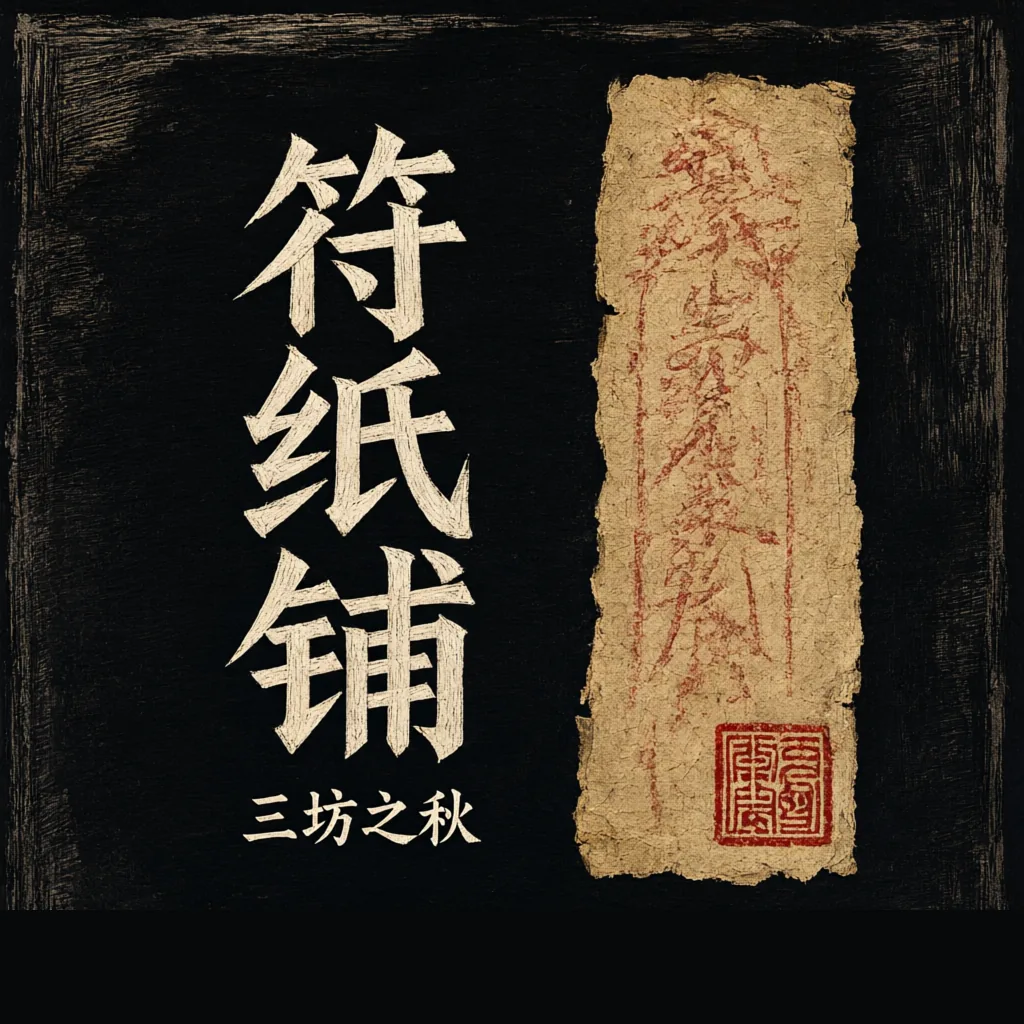
ZHF GAMES · 游戏官网
Sealwright: The Autumn Assize
在楮城三坊交界,接过一间符纸铺。白天听人和妖讲述来意,查书辨证,决定如何落笔;夜里,再把今日的选择与后果一一理清。
你要判断每位来客的难处,再决定画符、用药、改环境,还是开口劝解。事情的真相与你交给衙门的呈报,可以是两种写法。
你写你相信的符,也交你过得去的呈报。
白日里问诊、查书、画符;打烊后,回看今日的处置与余波。
翻阅妖物志、符谱与药录,把来客的话和书上的线索放在一起判断。
画符不是唯一的办法。用药、改换环境,或只劝一句,也可能更合适。
你看见的实情,和最终交到衙门的呈报,不必写成同一句话。
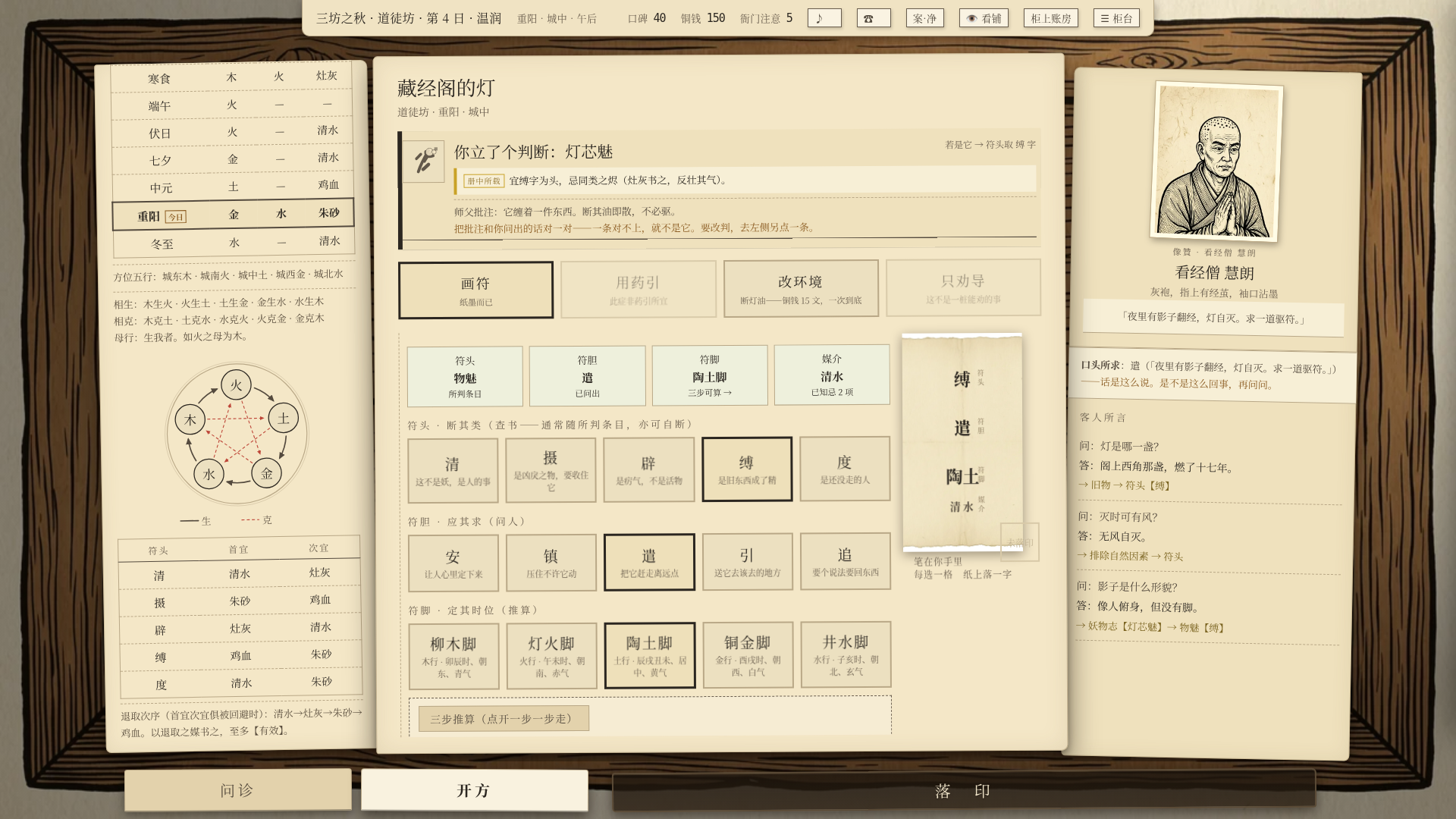
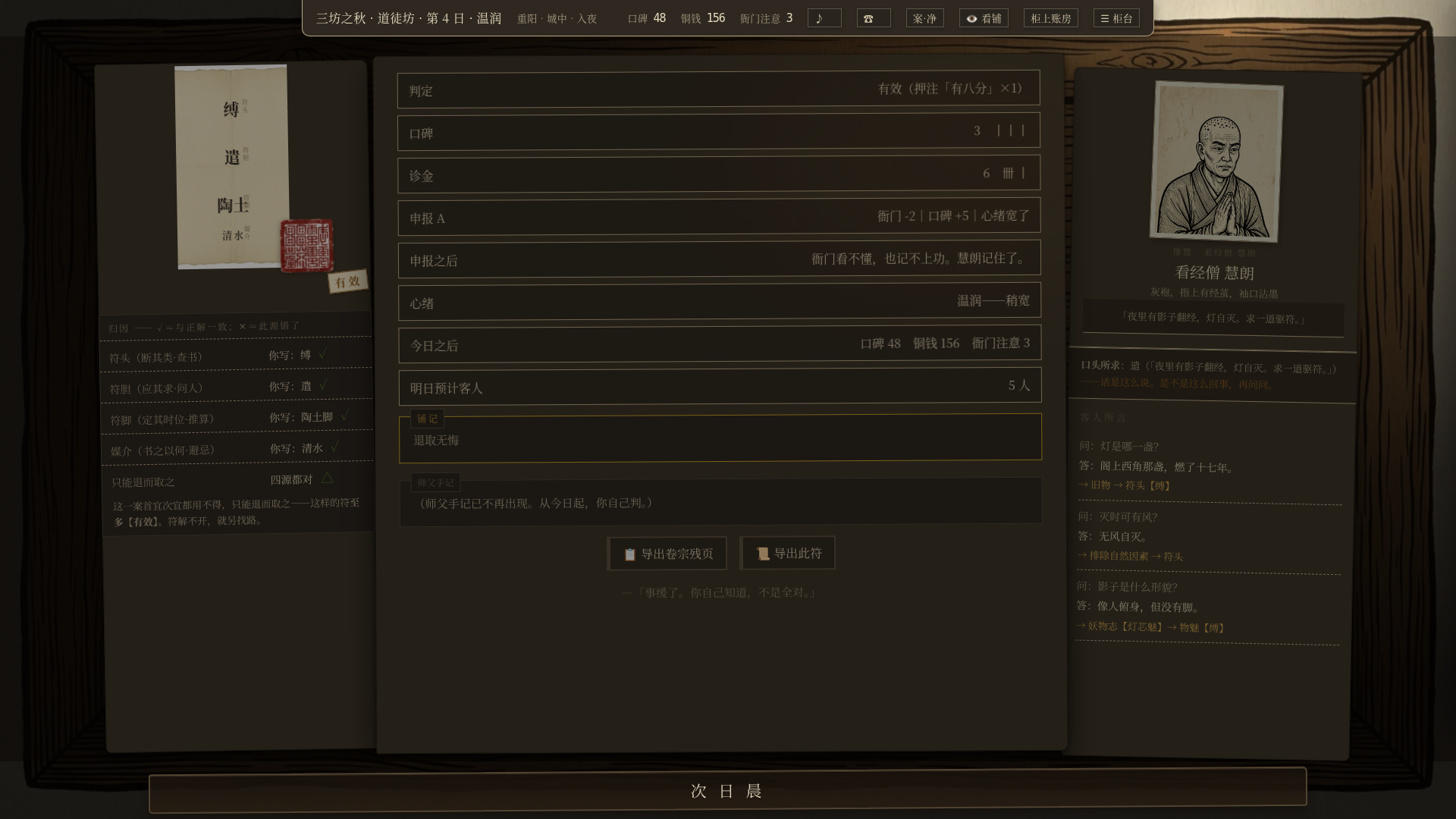
以下为游戏实机截图。
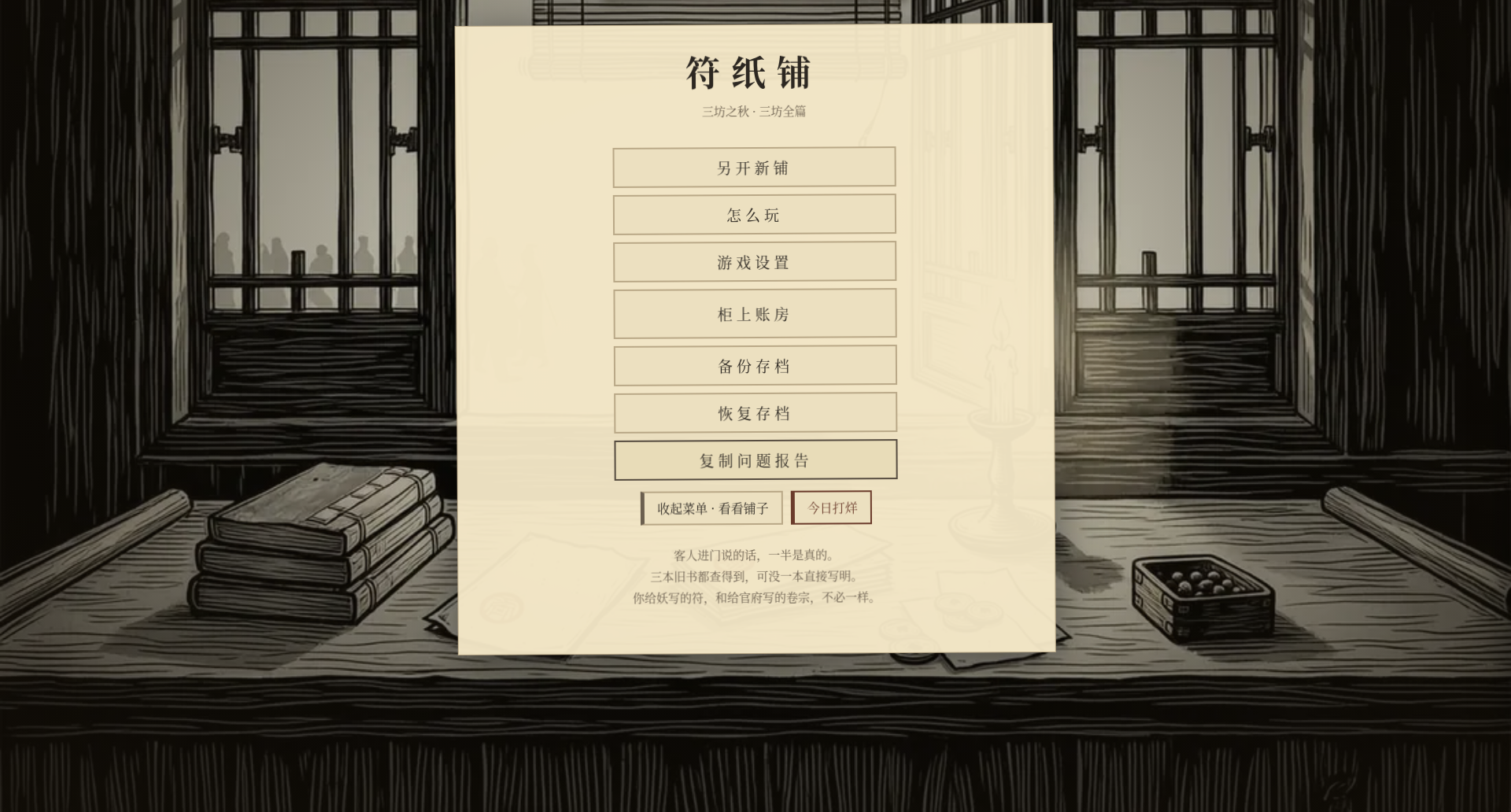
一篇序章与八篇手记,按开发过程整理。选中一篇即可在此页阅读。
记录开发历程,写于 2026 年 11 月,回顾 2026 年 6 月以来的工作。
我喜欢这一类关于符纸、画符的中国古代故事,也看过不少相关的影视和书。后来就老想一件事:要是能穿越回去,做一名画符人,摆个摊,如果还能有一间自己的铺子就好了。有人上门,就帮他把事情弄明白,这就是我想过的一天。
《符纸铺:三坊之秋》就是顺着这个心愿做起来的。我不是想在这里重讲游戏里的案子,只是在 2026 年 11 月回头看:从 6 月那一版想法,到后来不断往回收、把含糊的地方改掉,中间到底做了哪些取舍。这组笔记收在游戏官网里;它们不是游戏本身,也不会重讲案子。
下面八篇按开发的先后写,不是按哪一天提交的。
这批开发笔记是简单整理出来的,我抽空会继续写更详细的笔记,可能不是开发笔记,而是世界观、角色设定和身份、游戏细节,或者,如果玩家感兴趣,我可以把完整的幕后细节公开出来。
回顾 2026 年 6 月,我的心愿,和最初想做的那间店。「不知何朝何年。楮城三坊交界,一间符纸铺。」
2026 年 11 月写这些的时候,我还是先回到 6 月。那时我想做的,是一间天天开门的符纸铺。客人带着怪事上门,我会问客人问题,然后翻书,然后开方和画符,最后看着符纸生效,这就是我当时对这个游戏的所有想象。
心愿其实很简单。我一直喜欢这类题材的影视和书,也一直想穿越到古代做画符人,有摊、有店。我刚才在序章里说过的那些,都不是后来硬凑的设定——有人带着怪事上门,我翻书、判断,落笔,这就是我一开始想做的东西。
在 6 月的概念里,我曾把铺子放在一个更具体的历史城里:北魏的洛阳。后来对外定下来的句子改成:「不知何朝何年。楮城三坊交界,一间符纸铺。」英文是:Some dynasty, some year. In Chucheng, where three wards meet, there is a talisman shop. 商店页和游戏里对外只留楮城。我不想写真实的历史朝代,因此设计了一个架空的城市,但故事和角色风格和风俗参考了南北朝到唐宋的某些元素。
6 月那阵,我也看过一些靠升级过关、甚至还有战斗系统、数值打怪推进的游戏,包括 RPG 游戏我也调研了很久,但是我觉得这些都不适合我,最终觉得应该设计成那种把一件事问清楚、再落笔画符的乐趣,适合放在一间符纸铺里来做。我不打算做成某款游戏的仿作,更不打算做成一款大作品或者超级爆款。只希望能把这类题材做得有趣、有代入感,让玩家成为那个画符人,而不是做一个普通的 RPG 玩家。
回顾 2026 年 6 月下旬,有沮丧也有欣慰。
6 月下旬,我先做成一版能在浏览器上打开的原型。屏幕按手机竖着排。把「问诊、查书、开方」这条线跑通了。还剩最后一个环节:夜里把符纸交给求符的人,然后看结果。当时没做。
6 月 24 日,两位朋友试了最早那一版,几乎看不懂。问题被记下来的是这几条:玩法没有讲清楚;配方用的是文言文;每一步该做什么也看不明白。我没有记下他们当时的原话,也不想在这里编。
随后我做了几件很具体的事。补了步骤,给前几日加了说明;条目下添了白话批注,原文留下,旁边再写一句能读懂的话。封面也改成真正的主菜单,这些改动来自那次试玩,不是事后想象出来的功能清单。
就在这几天,画面方向也定了:走克制的水墨木刻,而不是更艳的工笔重彩。这一笔我放到后面谈游戏界面的那篇再展开。这里只想记下,一开始很早就定方向了,因此很早就做了原型。
最初版本的原型是这样的,游戏开局,玩家就会面对第一个客人:一个焦急的年轻人,说是他家祖坟地被一伙强盗挖了。强盗头子还带人来他们家砸了场子,他们家现在家徒四壁,他急着想把地要回来,但打听下来强盗已经搬到城东去了。年轻人想求符纸镇住强盗,还想让强盗把挖走的东西原封不动还回来。玩家能做的,是问清楚更多细节,然后翻书找到对应的符纸方子。
那阵子我写了不少这种短故事,有的关于强盗、有的关于闹鬼,有的涉及买卖、家庭矛盾,有的就是一些简单的怪力乱神。写着写着,也渐渐确定了故事的整体结构:大部分事件都是单元剧,有明确的起因、经过和结局,不会特别拖沓,也不会强制玩家为了推进剧情必须做某些选择。有的故事有不止一种解决方式,但不会有复杂的“分支路径”,也不会因此产生什么好坏结局,更多的是体验不同的解决路径。
但是最终的版本,我把第一个客人换成了别的角色,也说不清到底是什么原因,可能是因为我有选择恐惧症,我脑子里的短故事积攒的太多了,我都不知道该选择哪些好,找个时间再重新梳理、归类。或许以后会把这些故事再找个地方展示出来。
回顾 2026 年 7 月,方向大幅调整,但是也有自己的坚持。
6 月的概念里,我曾经想把铺子设定为可以一直开下去,每天都能接案子,每一局都要拉得很长。但是在 7 月我把它收了回来:三个坊,二十个案子。不是想故意减工作量,首先是那么多个案子我根本写不完,就算写完了玩家也未必看得完,不如把量放到一个我能把每件事都写扎实的范围里。而且从叙事角度来说,主人公应该有自己的成长路线,不能一上来就有自己的铺子,不是什么都能接得住,因此我设计了一个叙事,铺子是师父留下的,玩家需要临时打理,最后经营的怎么样,看玩家的表现就行。这样的话,也就不需要做那么多案子,逻辑上也说得通了。
主画面也横了过来。左边是书,中间是正在写的纸,右边是来客。竖着的手机屏不再作为正式形态。在桌面上打开的一版:三列并排,在手机上会读不清。它就该像摊在桌上的东西,不该像个悬浮菜单。于是我最终放弃了手机端,改成了桌面PC端专用的版本。我不后悔这个决定。如果必须要做手机端,那就是另外的设计方案了,以后有机会再考虑。
玩家要面对的事,对方可能是妖,可能是病,也可能只是人们自己的事。得先判断这是哪一类,再决定怎么落笔。而玩家自己,可能是驱魔人,也可能是审判者,也可能是治病的人。
回顾 2026 年 8 月的转向,以及 10 月底仍坚持的原则。
关于查书这件事,我后来改了想法。如果只是在某一册里找到一条就照着抄,整个铺子的界面就成了翻页器。符要能推理:头、胆、脚,以及用什么来写,选错了得说得出原因,而不是一句「你没翻到那一页」。有的案子里面,最好的办法不一定是画符。改一改环境,用一用药,或者只劝一句,也可能更合适。
8 月把这条转向定下来以后,还有一件事一直在拖。10 月 31 日我把自己仍坚持的原则又说清楚了一遍。最开始,我是想让人自己探索,不给压力,也不说教。可是如果一开始完全摸不着门,也就谈不上探索。要把游戏怎么玩先讲明白,最好在一两个教学案子里学会;学会以后,就不要再插手他怎么选。不要写没人会看的长篇攻略,但得让人知道往哪儿走。探索要有路径,不能一直是懵的。
第一案里有些提示,后来我自己也觉得不够。于是还是在前 3 个案子里增加了一些引导提示,后面的案子里就没有做提示了。
回顾一天的节奏,白天问诊,夜里复盘结算,看看自己的付出是否有效果。
前面提到的开门、问诊、落笔,都发生在白天。但真正让我想做这间铺子的,是一天结束以后的那段时间——把门关上,坐下来,翻一翻今天到底做对了多少。游戏里每一天都有这两截:白天忙碌,晚上算账。
白天在铺里问、查、写、落印。我把纸的风格设计成了暖色的,案子一件一件来。入夜,再把今天的结果摆回桌上。白天暖色,夜里整桌暗下来。白日里顾不上细看的地方,这会儿才摊开。上面两张图就是这个意思——白天那张是亮色的;夜里那张就会暗下来,其实是在对账和结算。
要是只有白天忙,没有晚上坐下来想,这间铺子对我来说就少了一半。
但其实有一个地方没有展示出来,例如符纸具体是如何生效的、客人拿到符纸后都做了什么,这些都没有在游戏里体现出来,只用了入夜的结算画面来展现。这些会作为待办事项,如果玩家对游戏感兴趣,我就会加快节奏做这些。
2026 年 9 月定下的选择,我相信,应该有自己的坚持和原则,这也是叙事的一部分。
9 月把卷宗这件事定下来的时候,我想清楚的是两栏,不是一句漂亮的反转。每案结束,你看见的实情是一栏,你写给衙门的呈报是另一栏。它们的内容可以不一样。商店页上那句短句——「你画你相信的符,也能报你认为能报的呈报。」,英文是 Write the talisman you believe. File the report you can live with. ——说的就是这个意思。
处置也不只有画符。前面已经说过,有时用药,有时改环境,有时只劝一句。你怎么处理今天这桩事,会影响铺子往后的日子过的怎么样。判错了,事情不会立刻消失,还可能会有更糟的后果。
我希望玩家在这里停一下,我觉得这两件事都不轻松——你信什么,你愿意向衙门写什么,它们不必是同一个答案。后面的事就不在这里写了。
回顾 9 月确立的方案,继续优化迭代。
画面方向:克制的水墨木刻,配上暖的纸色,而不是大红大绿的刻板装饰。我喜欢那种像印在纸上的感觉。
朱砂尤其要省着用。9 月写下用色的约束时,我给自己定了一条:这种红只点在收回不来的决定上,不当普通警告,也不拿来铺装饰。不能到处用红色,否则到处都是重点,反而看不出哪一笔才是真要紧的。
界面也尽量像摊在桌上的东西:纸、书、印。不要做成浮在画面上的现代按钮。人坐下来,先看见案几,而不是一套被设计过的面板。整体用暖的纸色、沉一点的墨,线条尽量淡;这些我按游戏里已经在用的来,不必把色号念给读者听。能让人看着舒服就行,不用再往上面堆花纹。
回顾 10 月下旬到 11 月的准备。
10 月底到 11 月,我把很多时间花在英文翻译,以及怎么把这间铺子交到玩家手里。英文要让人能看懂,能玩得下去。书页可以带一点味道,规则和界面必须要写清楚。符纸上的汉字留下,旁边再给能读的英文。坊名用意译,人名单用拼音加称谓。yao 和 yaoguai 这些词在英文里保留,不另造一个更容易被忘掉的替换。
对外的地点只说楮城,英文是 Chucheng。商店页和游戏对外不再使用更早那个具体的历史地名。
三册在中文里仍叫妖物志、符谱、药录。英文界面里是 Bestiary、Talisman Book、Remedy Book。
我正准备以桌面下载的方式把游戏交给玩家:在 itch 上提供压缩包,解压后用浏览器打开,可离线,不采集数据。
这款游戏由我独自完成,过程中使用了人工智能工具。音乐和音效全部由苏诺之音生成,再由我筛选和编辑;肖像和纹理先生成,再由我整理;写作和英文翻译有工具协助,最后仍由我改定。设计、写作、代码的署名是 ZHF Games;游戏官网也以 ZHF Games 为品牌。
ZHF Games 是一个专注于原创游戏与互动体验的独立游戏品牌。
本页为静态网站,不使用 Cookie 或访问统计,也不收集个人信息。游戏可离线运行,不收集数据,存档保存在你的浏览器中。点击 itch.io 链接会跳转至 itch.io。联系邮箱:hello@zhfstudios.com。
ZHF GAMES · OFFICIAL GAME SITE
《符纸铺:三坊之秋》
At the meeting of Chucheng’s three wards, you inherit a talisman shop. By day, listen to human and yao clients, consult the books, and decide what to write. At night, reckon with the choices and consequences the day has left behind.
Work out what troubles each visitor, then choose how to respond: draw a talisman, prescribe a remedy, change the surroundings, or offer advice. What you learn about a case and what you report to the authorities need not be the same.
Write the talisman you believe. File the report you can live with.
Take on clients, consult the books, and draw your conclusions by day. After closing, review what your decisions have set in motion.
Read the Bestiary, Talisman Book, and Remedy Book. Weigh what each client says against the clues in the books.
A talisman is not always the answer. A remedy, a change of surroundings, or a word of advice may fit better.
What you believe happened and what you choose to report to the authorities can be two different things.
Captured from the game.
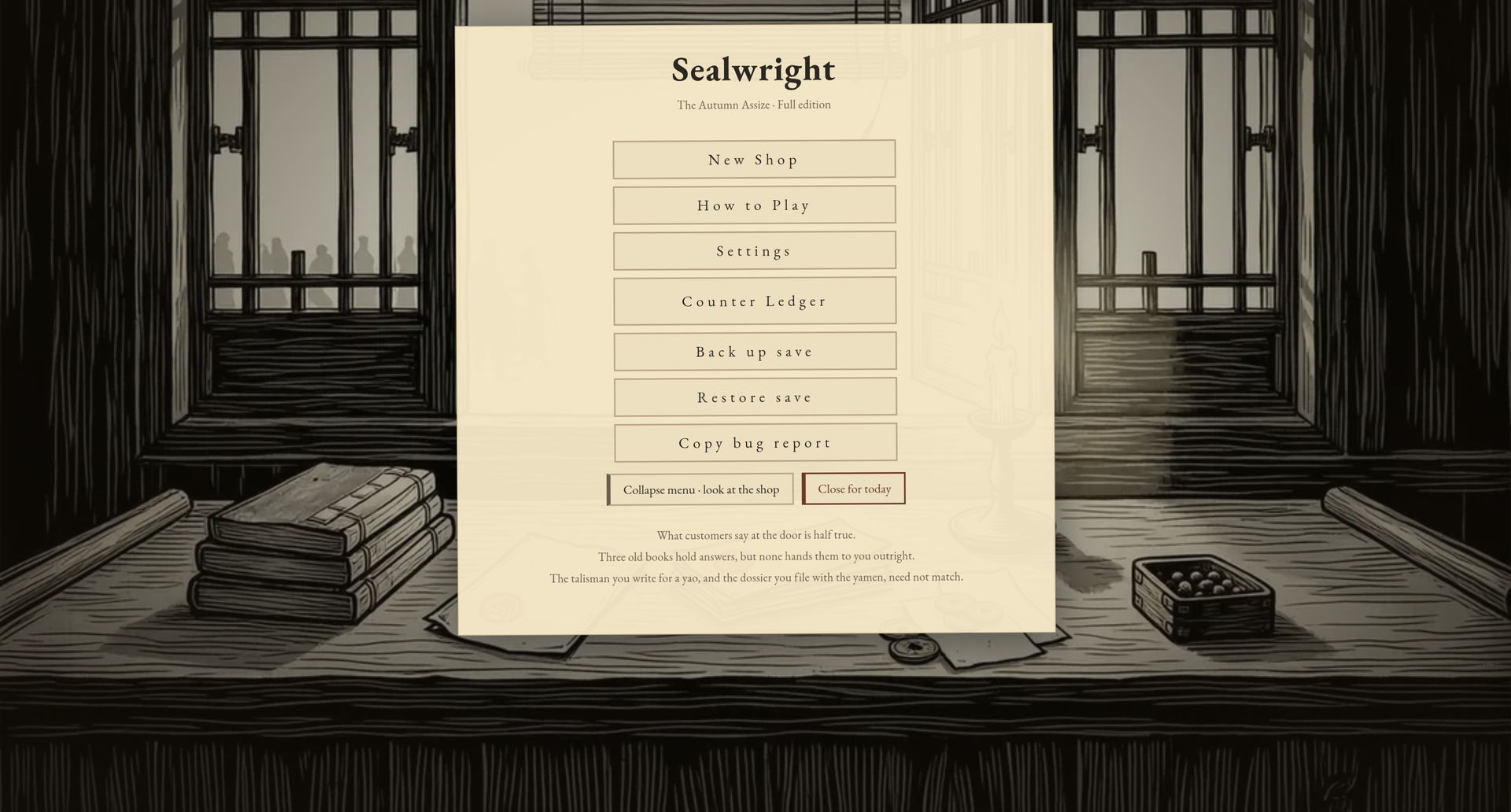
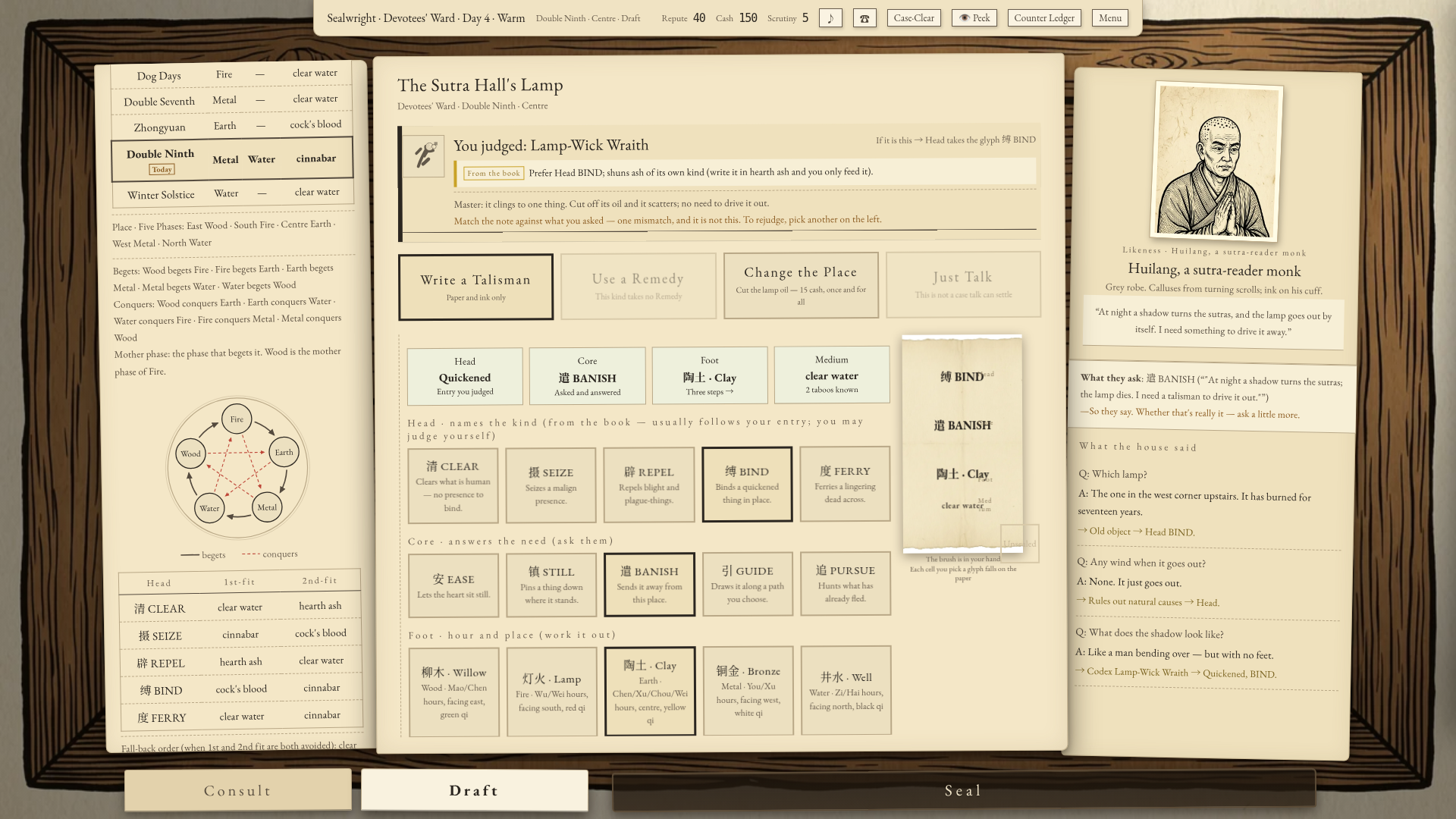
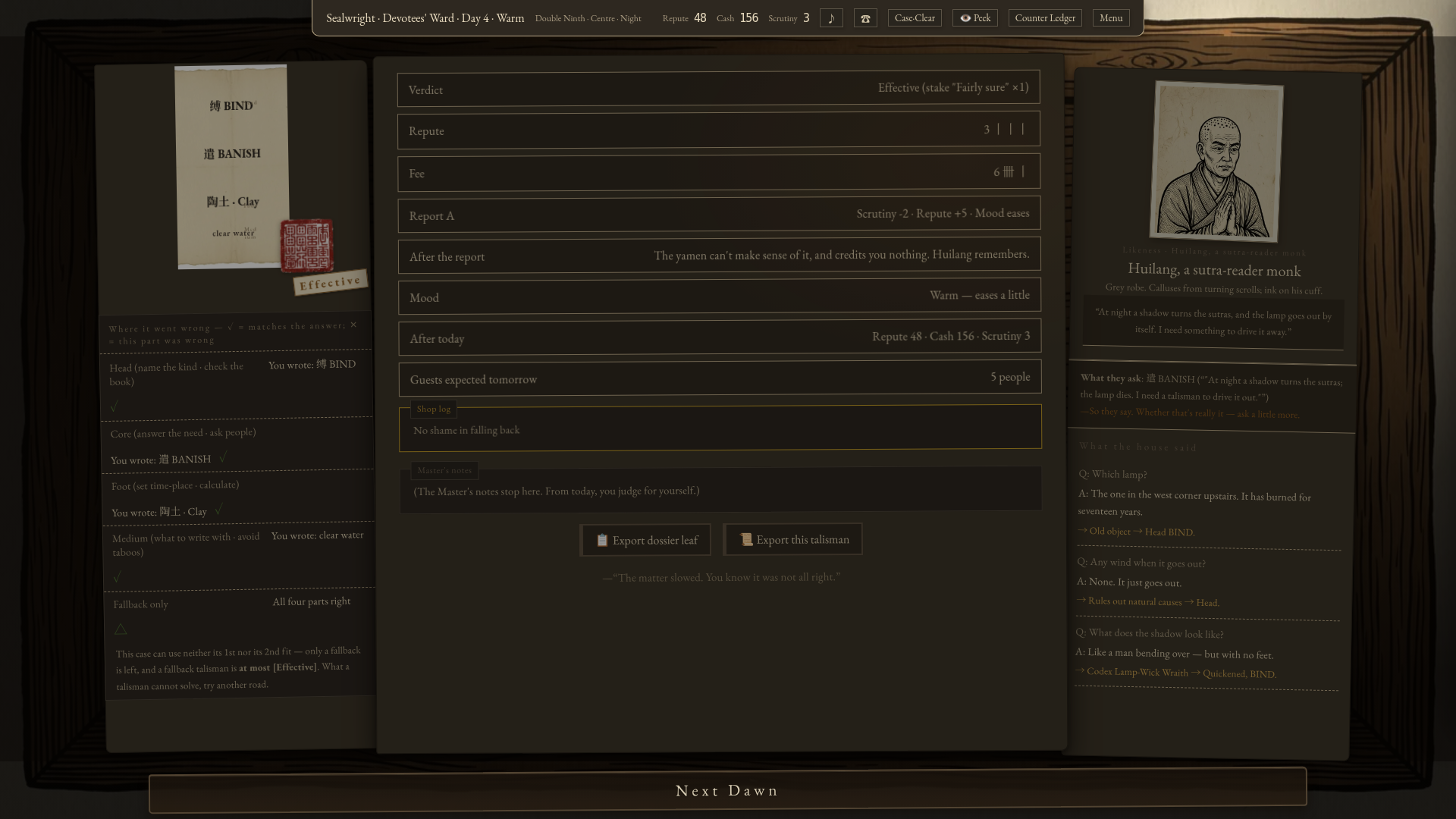
A prologue and eight pieces, arranged in the order the work unfolded. Select one to read it here.
Written in November 2026, looking back at the work since June 2026.
I have always liked Chinese historical stories about talisman paper and drawing talismans, and I have watched and read quite a few films and books about them. For a long time, I kept thinking: what if I could go back in time, become a talisman writer, set up a stall—and, if I could, have a shop of my own? When someone came by, I would help them get to the bottom of their trouble. That was the kind of day I imagined.
Sealwright: The Autumn Assize grew out of that wish. I am not here to retell the cases in the game. Looking back in November 2026, I want to trace the choices I made—from the idea I had in June to the later rounds of cutting things back and making unclear parts clearer. These notes live on the game’s official site; they are not the game itself, and they will not retell its cases.
The eight pieces below follow the order in which the game took shape, rather than the dates of individual commits.
These notes are a brief account. When I have time, I will write more—perhaps not as development notes, but about the world, the characters and their roles, or details of the game. If players are interested, I may share the full story behind the scenes.
Looking back at June 2026: the wish, and the shop I first imagined. “Some dynasty, some year. In Chucheng, where three wards meet, there is a talisman shop.”
As I write this in November 2026, I find myself going back to June. What I wanted to make then was a talisman shop that opened every day. A customer would come in with something strange troubling them. I would ask questions, consult the books, prescribe a remedy or draw a talisman, and then watch it take effect. That was the whole game as I imagined it at the time.
The wish was simple. I have always loved films and books about this subject, and I have always wanted to travel back in time and become a talisman writer, with a stall and a shop of my own. What I said in the prologue was not a setting I made up later to fit the game. Someone comes in with a strange problem; I consult the books, make a judgment, and put brush to paper. That was what I wanted to make from the beginning.
In the June concept, I placed the shop in a more specific historical city: Luoyang, during the Northern Wei. The line I eventually settled on for the public version became: “Some dynasty, some year. In Chucheng, where three wards meet, there is a talisman shop.” The Chinese reads: 不知何朝何年。楮城三坊交界,一间符纸铺. The store page and the game now name only Chucheng. I did not want to set the story in a real dynasty, so I created a fictional city, drawing on selected cultural and social details from the Northern and Southern Dynasties through the Tang and Song.
Around June, I also spent a long time researching games built around leveling up, clearing stages, combat systems, or numerical progression—including RPGs. None of those approaches felt right for this game. I came to think it should focus on the pleasure of getting to the bottom of a problem and then deciding what to write, all within a talisman shop. I do not intend to imitate another game or make a huge production or a blockbuster. I only hope to make this subject engaging and immersive, so players can become the person drawing talismans, rather than just another RPG player.
Looking back at late June 2026, with both frustration and relief.
In late June, I first made a prototype that could be opened in a browser. The screen was laid out vertically, like a phone. I had the “ask, consult, prescribe” loop working. One last part was still missing: at night, hand the talisman to the person who asked for it and see what happened. I had not built that yet.
On June 24, two friends tried the earliest version and could barely understand it. I wrote down a few problems: the rules were unclear; the recipes were written in classical Chinese; and it was hard to tell what to do at each step. I did not record their exact words, and I do not want to invent them here.
Afterward I made a few concrete changes. I added steps and explanations to the first few days. I kept the original wording in the entries, then added plain-language notes beside it. I also changed the cover into a proper main menu. These changes came out of that playtest; they are not a feature list I made up afterward.
Around then, I also settled on a visual direction: restrained ink-and-woodcut imagery, rather than brightly colored, meticulous paintings. I will discuss that choice in more detail in the piece about the game’s interface. For now, I only want to note that the direction was set early, which is why I started prototyping so soon.
This is what the first prototype looked like. The game opened with a worried young man: a band of outlaws had dug up his family’s ancestral grave. Their leader had also brought men to ransack his home, leaving the family with almost nothing. He wanted to reclaim the grave plot, but he had heard that the bandits had moved to the east of the city. He asked for a talisman to hold them in check and make them return everything they had taken, untouched. The player could ask for more details, then search the books for the right talisman recipe.
I wrote many short stories like this at the time: some about bandits, some about hauntings, some about trade or family disputes, and some about uncanny things. As I wrote, I gradually settled on the overall structure. Most cases would be self-contained episodes with a clear beginning, middle, and end. They would not drag on, and players would not have to make particular choices just to move the plot forward. Some cases would have more than one solution, but no elaborate branching paths or simple good and bad endings. The point would be to experience different ways of resolving a problem.
In the final version, though, I replaced the first client with someone else. I cannot quite say why. Maybe I have a hard time choosing: I had accumulated too many short stories in my head and could not decide which ones to use. I will have to sort and group them another time. Perhaps I will find another place to share them later.
Looking back at July 2026: a major change in direction, with a few things I held on to.
In the June concept, I imagined a shop that could stay open indefinitely, taking cases every day and making each playthrough quite long. In July, I pulled that scope back: three wards, twenty cases. I was not cutting the work just to make less of it. I simply could not write that many cases, and even if I did, players might not get through them all. I would rather keep the scope small enough to give every case the care it deserves. Narratively, the protagonist also needed room to grow; they could not begin with a shop of their own and be ready for anything. So I came up with a story in which the shop is left behind by a master, and the player has to run it for a while. How well it fares depends on the player. With that in place, fewer cases made sense, too.
The main screen turned horizontal as well. Books on the left, the paper being written on in the middle, and the visitor on the right. The vertical phone screen was no longer the intended format. On a desktop, the three columns sit side by side; on a phone, they become hard to read. The game should feel like things laid out on a desk, not a floating menu. So I ultimately dropped the phone version and focused on desktop PC. I do not regret that choice. If I make a phone version, it will need a different design, which I may consider someday.
The visitor might be a yao, a sick person, or simply someone dealing with a human problem. First you have to work out what kind of situation it is, then decide what to write. And the player’s role could be that of an exorcist, an adjudicator, or a healer.
Looking back at the change in August 2026, and the principle I still held to at the end of October.
I later changed my mind about researching the books. If the player only has to find an entry in one volume and copy it, the whole shop becomes a page-turning interface. Talismans should involve reasoning: the head, gall, and foot, as well as what to write with. When a choice is wrong, the game should be able to explain why, instead of just saying, “You did not turn to the right page.” And in some cases, drawing a talisman may not be the best answer. Changing the surroundings, using medicine, or simply offering advice might work better.
After settling on that change in August, one more question stayed with me. On October 31, I put the principle I still believed in into words again. At first, I wanted players to explore on their own, without pressure or a lecture. But if they cannot find their footing at all, there is no room to explore. The game needs to explain how to play, ideally within the first one or two tutorial cases. After that, I should stop interfering with their choices. I do not want to write a long walkthrough nobody will read, but players should have some sense of where to go. Exploration needs a path; it cannot leave you lost the whole time.
The first case had a few hints, but later I felt they were not enough. I added more guidance to the first three cases. There are no hints in the cases that follow.
Looking back at the rhythm of the day: hear cases, then review the results and see what came of your efforts.
The opening, the consultations, and the writing I mentioned earlier all happen during the day. But what made me want to build this shop was the time after the day was over: closing the door, sitting down, and looking back at what I got right. Each day in the game has those two halves: busy work by day, taking stock at night.
During the day, you ask, research, write, and stamp the talismans in the shop. I gave the paper a warm tone, and cases arrive one by one. At night, the day’s results come back to the desk. The warm daytime colors give way to a darker room. Details there was no time to look at during the day are finally laid out in front of you. That is what the two images above show: the daytime scene is bright; the nighttime one is dark. It is a review and reckoning.
Without the time to sit down and think at night, after a busy day, this shop would feel like only half the idea to me.
There is something the game does not show: exactly how a talisman takes effect, or what a client does after receiving one. For now, the game shows only the nighttime settlement. These are still on my to-do list. If players are interested, I will move faster on them.
In September 2026, I settled on a choice that should reflect what you believe and the principles you stand by. That, too, is part of the story.
When I settled on the case record in September, what I had in mind was two columns, not a clever twist. At the end of each case, what you believe happened appears in one column, and the report you submit to the yamen appears in another. They do not have to match. The short line on the store page—“Write the talisman you believe. File the report you can live with.”—is what I mean.
Drawing a talisman is not the only response. As I mentioned earlier, sometimes you can use medicine, change the surroundings, or simply offer advice. How you handle a case today affects how the shop’s future unfolds. If you judge it wrong, the matter will not simply disappear; things may get worse.
I hope players pause here. Neither choice feels easy to me: what you believe, and what you are willing to report to the yamen, do not have to be the same answer. I will leave what happens after that unwritten here.
Looking back at the direction set in September, and the refinements since.
The visual direction is restrained ink-and-woodcut imagery, paired with warm paper rather than stereotypical decorations in bright red and green. I like the feeling of an image printed on paper.
Cinnabar red needs to be used sparingly. When I wrote down the color rules in September, I set myself one limit: this red should mark decisions that cannot be taken back. It should not be an ordinary warning or decorative color. If red appears everywhere, everything becomes a point of emphasis, and the one stroke that truly matters will disappear.
The interface should feel like things spread across a desk: paper, books, and seals. I do not want it to look like modern buttons floating over the scene. The player should first see a writing desk, not a designed panel. The overall palette uses warm paper, deeper ink, and quiet lines, as in the game itself. There is no need to list color codes for the reader. It is enough if the scene feels comfortable to look at; it does not need more ornament.
Looking back at the preparations from late October through November.
From late October into November, I spent a lot of time on the English translation and on how to put the shop into players’ hands. The English needs to be clear enough to understand and play. The book pages can keep some flavor, but the rules and interface need to be plain. Chinese characters stay on the talismans, with readable English alongside them. Ward names are translated for meaning; people’s names use pinyin with a title. Words such as yao and yaoguai stay in English rather than being replaced with something easier to forget.
The only place name used publicly is Chucheng (楮城). The store page and the game no longer use the more specific historical place name from the earlier version.
The three books are still called 妖物志, 符谱, and 药录 in Chinese. In the English interface, they are the Bestiary, Talisman Book, and Remedy Book.
I am preparing to deliver the game as a desktop download: a compressed file on itch, which players can extract and open in a browser. It can be played offline and does not collect data.
I am making this game on my own, with the help of AI tools along the way. The music and sound effects were all generated with Suno, then selected and edited by me. Portraits and textures were generated first, then organized by me. Tools assisted with writing and English translation, and I revised the final versions. Design, writing, and code are credited to ZHF Games; the official game site uses ZHF Games as its brand as well.
ZHF Games is an independent game label focused on original games and interactive experiences.
This is a static page. It uses no cookies or analytics and collects no personal data. The game runs offline, collects no data, and keeps saves in your browser. itch.io links open itch.io. Contact: hello@zhfstudios.com.